


In today’s fast-paced, hypercompetitive world, building high-performing teams is no longer a “nice to have”—it’s essential for survival. But the secret isn’t about hiring rockstars or forcing longer hours. The secret lies in leadership: specifically agile leadership that unlocks team potential, fosters trust, and sustains performance.
Agile leadership flips the traditional top-down model. Instead of issuing orders, agile leaders enable, support, and co-create. They distribute decision-making, allow teams to self-organize, and encourage experimentation. Rather than relying on rigid structures, agile leadership thrives on adaptability, trust, and empowerment. When properly implemented, it transforms good teams into high-performing teams.
Why Traditional Leadership Fails — and Why Agile Leadership Works
Traditional leadership often assumes a top-down, directive style: leaders plan and assign, teams execute. This approach struggles in complex, volatile environments. When things change too fast, the central command can’t keep up. Decision-making bottlenecks, micromanagement, and low morale undermine performance.
Agile leadership flips that model. Instead of issuing orders, agile leaders enable, support, and co-create. They distribute decision-making, allow teams to self-organize, and encourage experimentation. Research shows that organizations embracing Agile leadership are far more likely to become top performers.
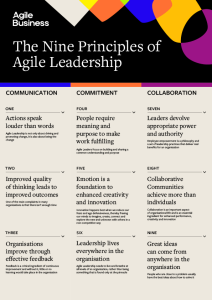
Core Principles of Agile Leadership for High-Performing Teams
1. Psychological Safety & Trust
Agile leaders foster psychological safety, empower teams with purpose, and ensure adaptability through distributed decision-making. They champion continuous learning, servant leadership, and organizational flexibility, helping teams achieve sustainable excellence.
2. Clear Purpose, Vision & Aligned Goals
Agile leaders foster psychological safety, empower teams with purpose, and ensure adaptability through distributed decision-making. They champion continuous learning, servant leadership, and organizational flexibility, helping teams achieve sustainable excellence.
3. Distributed Decision-Making & Autonomy
Agile leaders foster psychological safety, empower teams with purpose, and ensure adaptability through distributed decision-making. They champion continuous learning, servant leadership, and organizational flexibility, helping teams achieve sustainable excellence.
4. Incremental Delivery & Feedback Loops
Agile leaders foster psychological safety, empower teams with purpose, and ensure adaptability through distributed decision-making. They champion continuous learning, servant leadership, and organizational flexibility, helping teams achieve sustainable excellence.
5. Continuous Learning & Improvement
Agile leaders foster psychological safety, empower teams with purpose, and ensure adaptability through distributed decision-making. They champion continuous learning, servant leadership, and organizational flexibility, helping teams achieve sustainable excellence.
6. Servant Leadership & Coaching Mindset
Agile leaders foster psychological safety, empower teams with purpose, and ensure adaptability through distributed decision-making. They champion continuous learning, servant leadership, and organizational flexibility, helping teams achieve sustainable excellence.
7. Adaptive Structures & Flexibility
Agile leaders foster psychological safety, empower teams with purpose, and ensure adaptability through distributed decision-making. They champion continuous learning, servant leadership, and organizational flexibility, helping teams achieve sustainable excellence.
Lessons from Real Examples & Research
Studies show that high-performing teams outperform collections of individual stars because they focus on collaboration, trust, and shared goals. Agile environments encourage self-organization, continuous feedback, and leadership emergence from within the team.
Practical Steps to Build High-Performing Teams via Agile Leadership
– Start small & pilot
– Coach leaders and teams
– Build psychological safety rituals
– Empower decision-making
– Establish feedback loops
– Encourage continuous learning
– Scale and align across teams
Addressing Common Challenges & Pitfalls
Agile transformation often fails when organizations mistake rituals for mindset shifts. Leaders must avoid micromanagement, prioritize sustainability over speed, and focus on consistency across all levels.
Measuring Success: What Does a High‑Performing Team Look Like?
High-performing teams exhibit faster time-to-market, higher morale, improved quality, and continuous innovation. They demonstrate ownership, cross-functional collaboration, and long-term stakeholder satisfaction.
Conclusion: The Real Secret
The secret to building high-performing teams isn’t magic—it’s leadership that trusts, empowers, and enables. Agile leadership doesn’t demand compliance; it builds ownership. When leaders embrace agility, they create organizations that are adaptive, innovative, and resilient.
Ready to transform your team into a high-performing powerhouse? Begin your agile leadership journey today with the AI‑ACF Course by AgileBodhi. Learn hands-on how to apply agile frameworks, empower teams, and lead with purpose.
Visit https://agilebodhi.com/ to learn more or register for the upcoming batch.