


In today’s fast‑paced, unpredictable business landscape, many organizations find themselves wrestling with chaos: fragmented teams, unclear priorities, siloed departments, endless change demands, and employee frustration. The question is: how do you transform chaos into clarity, where work is aligned, people are empowered, and value flows continuously? The answer lies in embracing an Agile culture.
This blog explores how adopting Agile isn’t just about implementing frameworks or rituals; it’s about shifting culture, mindset, behaviours — and ultimately transforming the way your organization works and delivers value.
1. What does “chaos” really look like?
Before we can move to clarity, we need to recognise the symptoms of chaos. Common signs include:
– Teams working in isolation, unaware of dependencies.
– Decision‑making bottlenecked at the top.
– Frequent changes in priorities, leading to confusion.
– Lack of feedback loops and learning.
– Low morale, disengaged employees, minimal ownership.
– Delivery delays and poor responsiveness to change.
These stem from deeper cultural roots: command‑and‑control structures, rigid hierarchies, and a focus on individual performance over team success.
2. Why traditional transformations often fail
Many organizations try to “become Agile” by introducing new tools or ceremonies without changing the underlying culture. Agile fails when leadership, structure, and incentives remain unchanged. True transformation requires changing *how people think, lead, and collaborate*.
3. What does “clarity” mean in an Agile culture?
Clarity means a shared purpose, transparency in goals, empowered teams, and continuous feedback loops. Everyone understands what matters and how their work contributes to customer value.
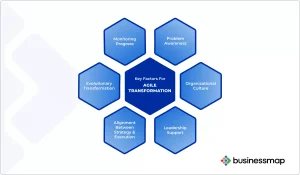
4. The cultural shifts required
Agile transformation requires three core mindset shifts:
– From **certainty → discovery**: Explore and learn continuously.
– From **authority → partnership**: Empower teams instead of commanding.
– From **scarcity → abundance**: Build trust and share information openly.
5. A roadmap from chaos to clarity
a) Diagnose current culture and pain points.
b) Define the “From → To” mindset shifts.
c) Build leadership commitment and role modelling.
d) Realign structures, processes, and metrics.
e) Embed learning and continuous improvement.
f) Scale and sustain the culture.
6. Benefits of the shift
– Faster responsiveness to change.
– Higher engagement and morale.
– Stronger collaboration across teams.
– Better customer focus and value delivery.
– Continuous improvement as a way of life.
7. Common pitfalls
Avoid surface-level adoption, leadership disconnect, and ignoring cultural measurement. Transformation is a long-term journey, not a checkbox exercise.
—
## 8. Why this matters now
In an era of hybrid work and global disruption, culture is your competitive advantage. Agile culture enables collaboration, innovation, and adaptability — essential for survival in fast-changing markets.
9. Practical first steps
– Choose a pilot team.
– Run a culture workshop.
– Define what “clarity” means for your business.
– Align leadership behaviour.
– Measure culture and outcomes together.
– Celebrate small wins and scale gradually.
. Final thoughts
Culture is the foundation of every transformation. Moving from chaos to clarity through Agile isn’t just a change in process — it’s a change in how people think, lead, and grow together.